Brutalist Art Deco Sideboard Refinished in Dark Brown Lacqua
Near This Piece
Vintage Design
Set of lounge chairs and java tabular array model 'Modular' produced by Herman Miller and designed past George Nelson in 1963.
The proposed piece was restored in the padding and coating.
For the upholstery we have chosen a 'soft touch' cotton material color cognac color (white cognac melange).
The set consists of a 2 -seater sofa with lateral table coffee and an armchair.
The coffee table tin can be mounted both on the left and on the right of the sofa.
There is this original metal product characterization (see photo)
The size of the sofa module are 228 ten 76 x h 69 cm
The size of the armchair are 76 x 76 ten h 69 cm
The footprint of the lounge mounted at the corner as in the photo are 228 x 152 x h 69 cm
* Please notation that items made of Rosewood are subject to a special consign process that may extend the delivery time an additional two to 4 weeks
| Creator | George Nelson |
|---|---|
| Manufacturer | Herman Miller |
| Blueprint Menses | 1960 to 1969 |
| Production Period | 1960 to 1969, 1970 to 1979 |
| State of Manufacture | The states |
| Identifying Marks | This piece has an attribution mark |
| Way | Midcentury |
| Detailed Condition | Restored — this vintage item is in very good condition because it has been refreshed through new upholstery and/or refinishing. |
| Restoration and Damage Details | Reupholstered, Repadded |
| Product Code | SAV-1282160 |
| Materials | Fabric, Iron, Laminate, Steel |
| Color | Copper |
| Width | 228 cm 228 cm |
| Depth | 76 cm 76 cm |
| Summit | 69 cm 69 cm |
| Seat Peak | 38 cm |
| Weight Range | Standard — Between 40kg and 80kg |
Shipping & Delivery
| Ships from | Italia |
|---|---|
| Returns | Returns accepted within ii days of commitment, except for Made-to-guild items |
| Carbon Neutral | For every purchase made, Pamono offsets 100% of estimated carbon emissions from global shipping. |
Delivery Options
| Front end Door Commitment: (Included in Every Order) |
|
|---|---|
| In-Domicile Delivery: (For in-home delivery service, additional fees utilize. Please get in touch) |
|
*Important Note
Delight examine every order upon delivery. In the event that there are visible signs of damage or missing or incorrect pieces, delight point the problem on the Commitment Note and contact the states within 48 hours of commitment. A signed delivery receipt without notations of missing, damaged, or incorrect item(south) represents your credence of the complete order in perfect condition.
Almost the Creator
George Nelson
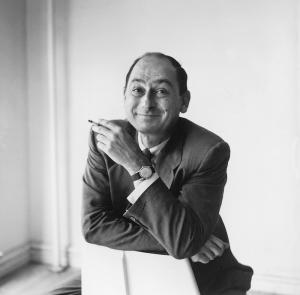
Designer, architect, and author George Nelson was born in Hartford, Connecticut in 1908. As a student of architecture at Yale University, he earned his Available of Arts degree in 1928 and his Bachelor of Fine Arts in 1931. Between 1931 and 1932, he studied at the Catholic University in Washington, D.C., at which point he won the Rome Prize, which provided a 2-yr stipend to report at the American Academy in Rome. While at that place, he conducted interviews with 12 leading architects of the day (including Le Corbusier, Mies van der Rohe, Gio Ponti, and Walter Gropius), which were published in the magazine Pencil Points.
In 1935, Nelson became acquaintance editor of Compages Forum and Fortune magazines, for whom he continued to work through the 1940s. His writing drew the attention of D.J. DePree, president of Michigan-based furniture manufacturer Herman Miller, and Nelson afterwards designed his first collection for the make in 1945; in 1947, he became the visitor'south pattern manager. In that location he designed hundreds of furniture pieces and recruited rise pattern talents including Isamu Noguchi and Charles and Ray Eames, among others.
In 1947, Nelson launched a studio in New York to design article of furniture, architecture, graphics, and exhibitions for clients such as General Electric, Olivetti, Abbott, and more. Over the years, the firm was known variously equally George Nelson, George Nelson & Associates, and George Nelson and Company, and its staff included the designers George Tscherny, Gordon Chadwick, Ettore Sottsass, Michael Graves, and Arthur Drexler. Landmark designs include the Bubble Lamps (1952), Coconut Chair (1955), Marshmallow Sofa (1956), and the Comprehensive Storage Organization (1959). In 1959, Nelson was lead designer for the American National Exhibition in Moscow, the site of a series of exchanges betwixt Vice President Richard Nixon and Soviet Premier Nikita Khrushchev, which became known as the "Kitchen Debate."
Over the course of his career, Nelson produced hundreds of designs for article of furniture, building, and graphics, as well as almost a dozen books and numerous magazine articles. He passed away in New York in 1986 at the age of 77.
About the Maker
Herman Miller
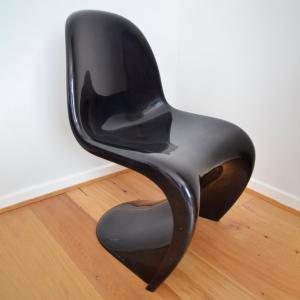
Herman Miller came into being in 1923 when a company man by the proper noun of D. J. De Pree (1891-1990) bought the majority shares of the Michigan Star Article of furniture Company, with the aid of his father-in-police, for whom he named the new venture. Like other furniture manufacturers in West Michigan at the time, De Pree focused on the production of replicas of ornate, 18th- and 19th-century European wood furnishings, until a defalcation scare brought on past the Great Depression drove him to seek a new direction. In 1931, De Pree brought in commercial creative person Gilbert Rohde, who convinced De Pree that honest, functional designs characterized by clean, elementary lines were the way forward—and thus set the form for Herman Miller'southward influence on what would become known as the midcentury modernistic fashion. Ii years later, the first Rohde-designed collection debuted at the Century of Progress Exposition in Chicago.
Later on Rohde passed away in 1944, De Pree hired architect-designer George Nelson every bit the company'south first official design manager. By crafting a new, compelling corporate identity and collaborating with some of the near visionary designers of the day—Charles and Ray Eames, Isamu Noguchi, and Alexander Girard —Nelson earned the company international acclaim. Under his leadership, Herman Miller created some of the 20th century's most iconic objects, such every bit the Eameses' DCM "Potato Bit" Chair (1945/46), Molded Fiberglass Chair (1950), and Eames Lounge Chair (1956); Noguchi's Noguchi Tabular array (1948); and Nelson's own Bubble Lamps (1955) and Marshmallow Sofa (1965), to name a few. Notably, the Activeness Office Project I series by Robert Propst (1964) paved the way for adjustable and semi-enclosed work environments (a.thousand.a. cubicles) at a fourth dimension when modernist design was increasingly adopted as the way for American corporate interiors. More recent office bestsellers include Bill Stumpf and Don Chadwick'south ubiquitous Aeron Chair (1994) and Studio 7.v'south high-tech, environmentally friendly Mirra Chair (2003).
Today Herman Miller and German manufacturer Vitra share many of the same licenses for midcentury mod masterpieces, the former sold in North America and the later in Europe. Much contend surrounds whether one produces better products than the other. The rivalry between the 2 companies notwithstanding, Herman Miller pieces have been extensively exhibited and acquisitioned into the permanent collections of institutions such every bit New York'due south Museum of Modern Fine art, London'south Victoria & Albert Museum, and even Weil am Rhein's Vitra Design Museum—and many, many more than.
* All images courtesy of Herman Miller.
lewismixtiffinuel.blogspot.com
Source: https://www.pamono.com.au/modular-sofa-coffee-table-by-george-nelson-for-herman-miller-set-of-2
0 Response to "Brutalist Art Deco Sideboard Refinished in Dark Brown Lacqua"
Post a Comment